WebToApp forks and executes real server runtimes — Node, PHP, Python, Go, WordPress — signs the bundle, and exports a Play-ready AAB, entirely inside the app. No PC. No build queue.
Most "website to app" tools stop at loading a page inside a WebView. WebToApp runs the actual backend, hardens the network layer, and signs the output — the parts a wrapper can't touch.
Node.js 18.20, PHP 8.4, Python 3.14, Go 1.26, and WordPress fork+exec as native binaries from app storage — like Termux, packaged into an installable APK.
DNS-over-HTTPS across 7 providers, TLS fingerprint spoofing through a local MITM bridge, and Encrypted Client Hello on the GeckoView engine to encrypt the SNI.
Binary AXML/ARSC patching, permission pruning, V1/V2/V3 signing, and Google Play-ready AAB export — all inside the app via apksig. No remote build queue.
WebGL, Canvas, AudioContext, ClientRects, timezone, fonts, WebRTC, and more — disguised at runtime, plus AES-256-GCM resource encryption.
Tampermonkey-style userscripts with a GM_* bridge, and live-searched Chrome Web Store extensions installed without rebuilding the host.
Generate web apps, modules, userscripts, and runtime projects from a prompt, with automatic retry on rate limits and a plan-mode you approve before it runs.
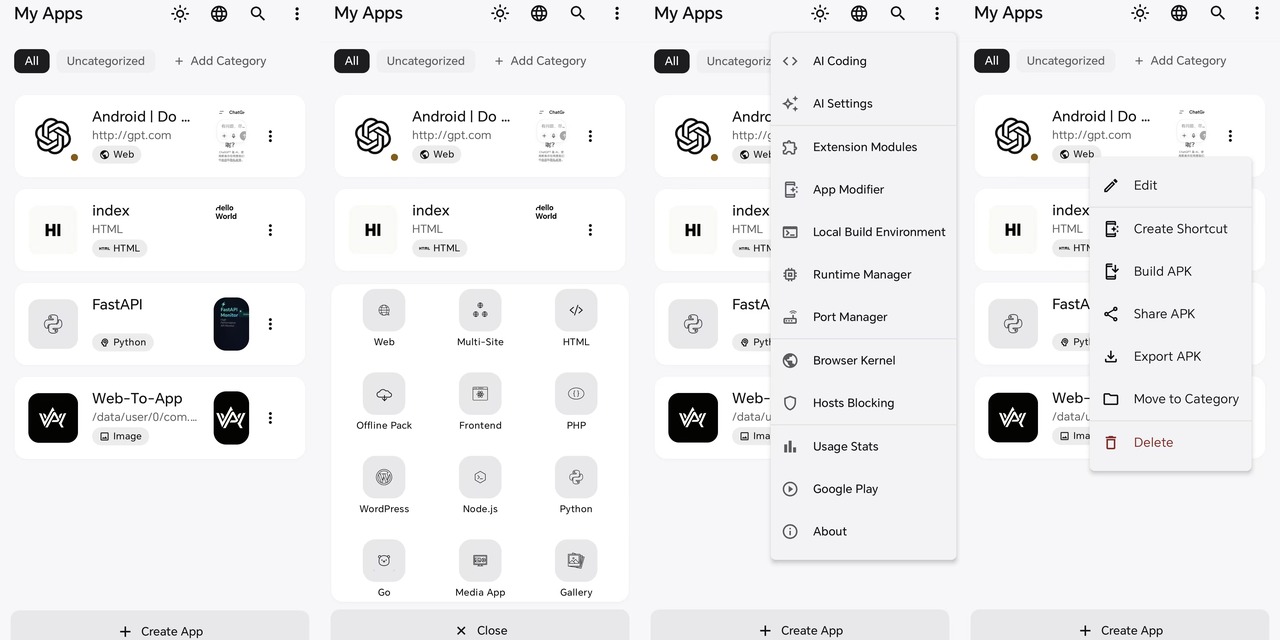
Landing pages, dashboards, and internal tools become a WebView-based APK.
React, Vue, and Vite builds run localhost-backed, fully offline.
Ships with an on-device local server — real prototypes, not mocks.
Runs over local PHP + SQLite — a portable, installable site.
Albums, course material, and portfolios as an offline viewer app.
Tabs, cards, feeds, or a drawer — a multi-web link hub in one APK.
Clone or re-brand it — icon, name, and package experiments.
Describe it in a prompt; the build engine generates and packages it.
Three Gradle modules do the work: the builder host, the runtime shell embedded into generated APKs, and the clone host used for app cloning.
Shared WebView/runtime behavior is authored once in app and synchronized into shell — core/shell, core/webview, core/engine, core/extension.
Template APKs are patched at the AXML/ARSC level, config and resources injected, permissions pruned, and the result signed with apksig.
ApkBuildCache keeps unsigned bases so repeat builds can go FULL, CONTENT_OVERLAY, or REUSE_UNSIGNED instead of rebuilding from scratch. Encrypted builds always take the full path.
The host pins targetSdk = 28 — that's what lets generated apps fork+exec native runtimes from app storage. The AAB exporter rewrites it separately for Play distribution.
Server runtimes and the optional GeckoView engine download on first use, keeping the base APK small.
No signing keys to lose track of, no build server to babysit. Pull the source or grab the latest release.